Skip to content
Carlo Miguel Dy
← Back to the specimen catalogue

Acc. XX · Plantula suspensa — prototype halted at the gate, cultivated 2026

Opsfleet — operations product, stopped at prototype by design

Product definition · Prototyping · 2026 · Independent studio

An operations product taken through phase-gated discovery — intake, research, PRD, low-fidelity then high-fidelity prototype — and deliberately stopped before any build, pending a go/no-go decision with collaborators.

Plantula suspensa — prototype halted at the gate, cultivated 2026

Field notes

The context

Not every product idea should get engineering time before it's been pressure-tested. Opsfleet is an operations product being explored with collaborators, and the question at this stage was whether the idea earns a build — not how to build it.

Cultivation

What I built

  • Ran Opsfleet through the studio's phase-gated discovery process: structured intake, research, a PRD, a low-fidelity prototype, and then a high-fidelity prototype, with an explicit approval gate before each phase could proceed to the next.
  • Stopped the process deliberately at the high-fidelity prototype stage rather than continuing into a build, keeping the decision about whether to invest engineering time separate from the act of prototyping itself.

Root system

How it works

No production architecture exists. The system that exists is process, not code: a sequence of gated phases, each producing an artifact (intake notes, research findings, a PRD, then prototypes of increasing fidelity) that collaborators review before authorizing the next phase.

Harvest

Outcomes

  • At high-fidelity prototype stage — no production implementation, no deployment, no users.
  • Being explored with collaborators; the outcome of prototyping is a decision, not a deployment.
  • No further work has been authorized past the prototype gate.

Herbarium

The work itself
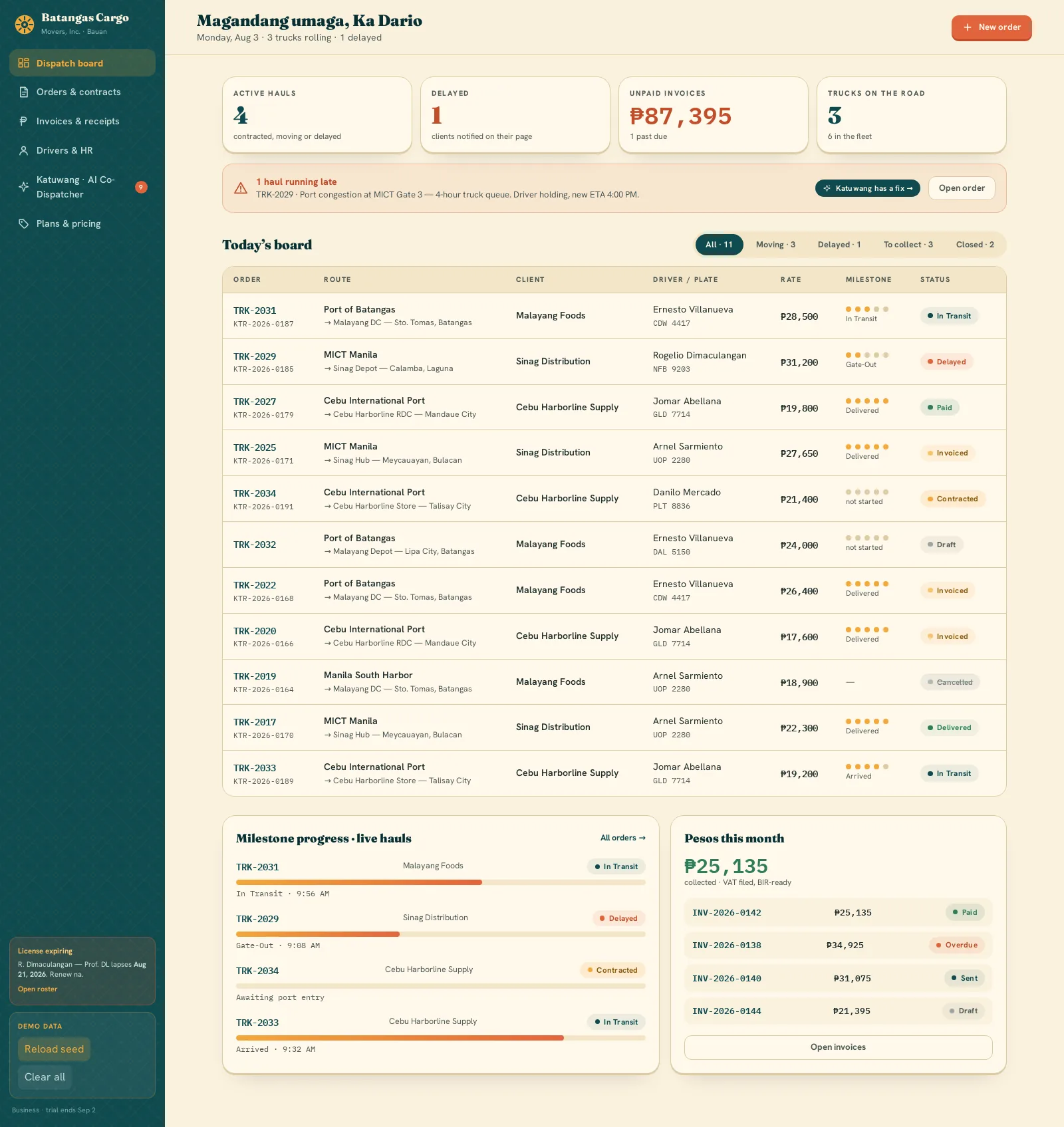
Operator dispatch board for the invented hauler 'Batangas Cargo Movers, Inc. · Bauan'. A dark teal left rail carries the brand mark and nav — Dispatch board (active), Orders & contracts, Invoices & receipts, Drivers & HR, Katuwang · AI Co-Dispatcher with an orange badge reading 9, and Plans & pricing — with a license-expiring alert and a DEMO DATA panel offering Reload seed and Clear all pinned at the bottom. The cream main area greets 'Magandang umaga, Ka Dario' above four KPI tiles — Active hauls 4, Delayed 1, Unpaid invoices ₱87,395, Trucks on the road 3 — and an orange callout reading '1 haul running late' with a 'Katuwang has a fix →' chip. Below that, 'Today's board' lists eleven hauls with status filter pills (All, Moving, Delayed, To collect, Closed), each row showing order number, route, client, driver and plate, rate, a five-dot milestone tracker and a status chip such as In Transit, Delayed, Invoiced or Delivered. Two panels close the screen: 'Milestone progress · live hauls' with progress bars per order, and 'Pesos this month' listing four invoices with paid/overdue/sent/draft chips and a running collected total.
Fig. 1The dispatch board's design direction: a single screen surfacing today's hauls, what's overdue, and which one Katuwang already has a fix drafted for — before the owner asks.
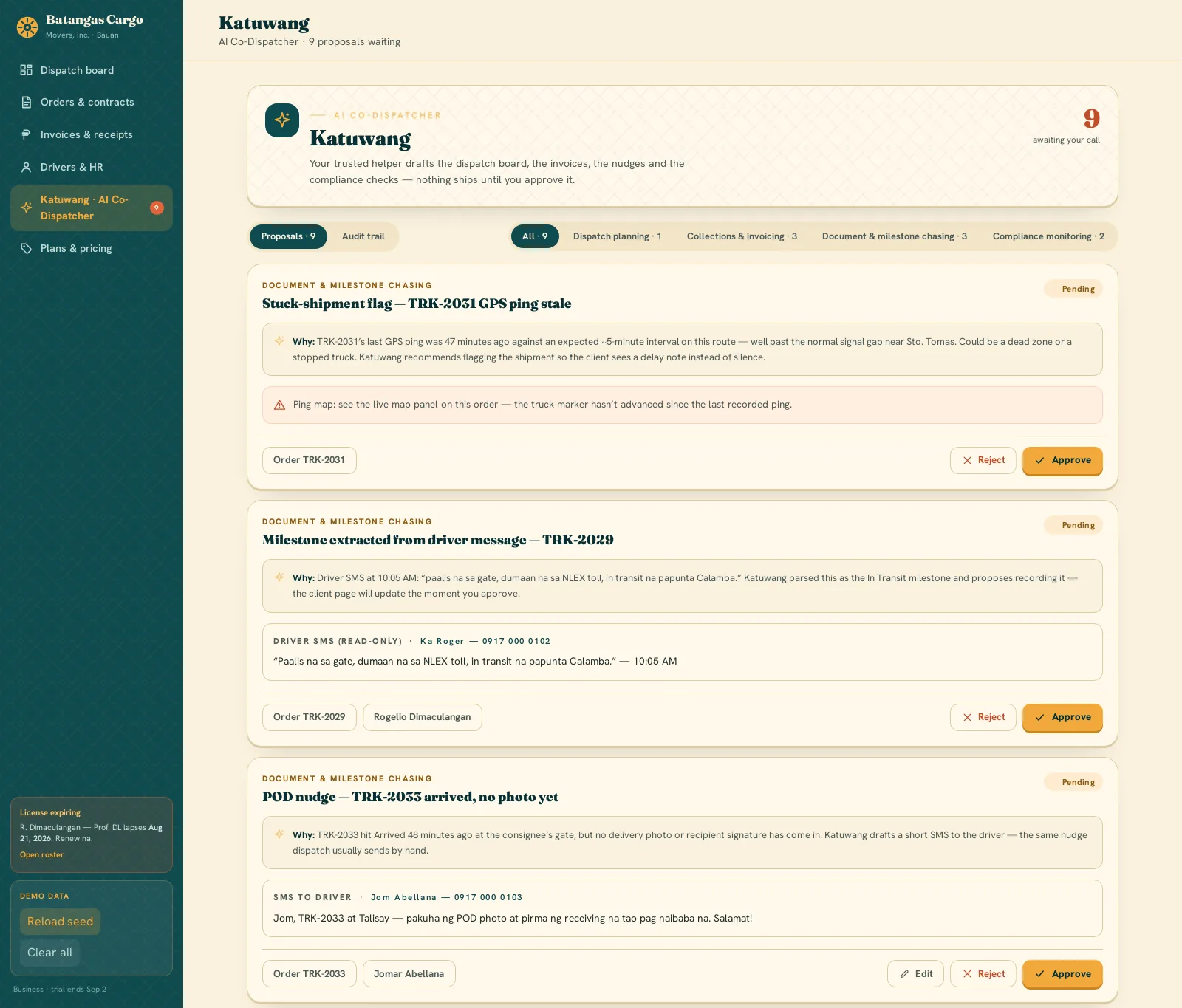
The Katuwang AI co-dispatcher inbox, same left rail with Katuwang active. A hero band reads 'Katuwang · AI Co-Dispatcher' and 'Your trusted helper drafts the dispatch board, the invoices, the nudges and the compliance checks — nothing ships until you approve it', with '9 awaiting your call' at top right. Below it sit Proposals and Audit trail tabs and workflow filter pills — All 9, Dispatch planning 1, Collections & invoicing 3, Document & milestone chasing 3, Compliance monitoring 2. Three full proposal cards follow, each opening with a 'Why:' reasoning block and a read-only draft preview, each ending in Reject and Approve controls: a stuck-shipment flag for order TRK-2031 noting its GPS ping is 47 minutes stale against the route's expected interval; a milestone the system parsed out of a driver's Tagalog SMS for order TRK-2029, shown with the original message and an Edit control alongside Reject and Approve; and a proof-of-delivery nudge for order TRK-2033 with a drafted Tagalog SMS to the driver asking for a POD photo and signature. The lower rail carries the same license-expiring alert and DEMO DATA panel with Reload seed and Clear all seen on the dispatch board.
Fig. 2Katuwang's proposed pattern: every draft — a GPS flag, a milestone parsed from a driver's text, a nudge SMS — states its reasoning and sits behind Approve, never firing on its own.
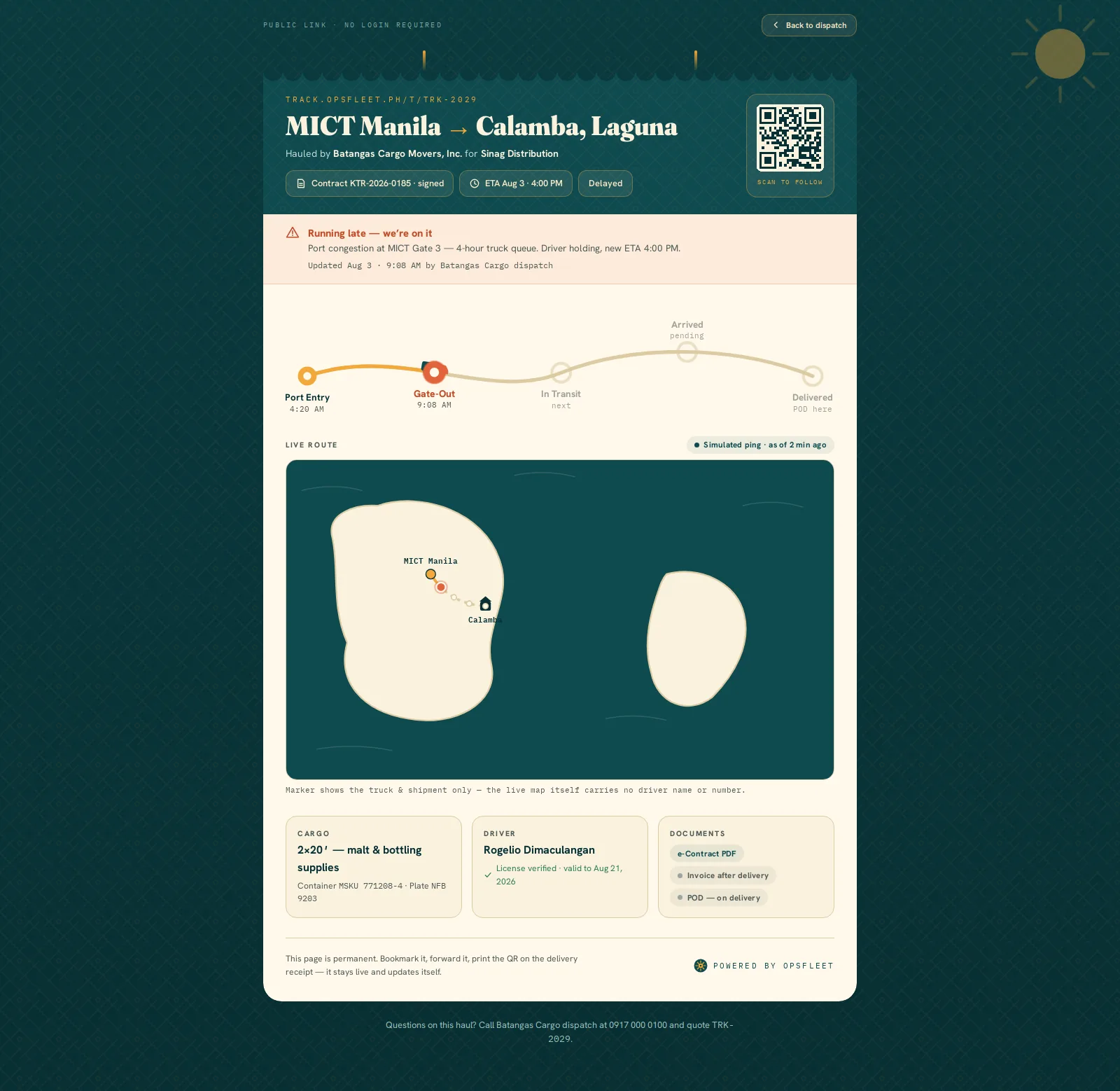
The public customer tracking page design, dark teal with no app chrome, headed 'PUBLIC LINK · NO LOGIN REQUIRED' with a 'Back to dispatch' link. A scalloped cream card shows the URL track.opsfleet.ph/t/TRK-2029, the route 'MICT Manila → Calamba, Laguna', 'Hauled by Batangas Cargo Movers, Inc. for Sinag Distribution', chips for a signed contract, an ETA and a Delayed status, and a QR code captioned 'scan to follow'. Below it an orange banner reads 'Running late — we're on it', explaining port congestion at MICT Gate 3 with a 4-hour truck queue and an updated ETA. A five-stop milestone route bar follows — Port Entry, Gate-Out (current), In Transit, Arrived, Delivered — then a 'LIVE ROUTE' panel with a hand-drawn map, a 'Simulated ping · as of 2 min ago' chip, and a note that the marker shows only the truck and shipment, carrying no driver name or number. Three cards close the page — Cargo (container and plate), Driver (name and license-verified status, no phone number shown), Documents (contract, invoice, POD) — above a footer noting the page is permanent and bookmarkable.
Fig. 3The differentiator: a permanent, no-login tracking link per haul, built so the client sees the delay and the fix in real time — with the live map deliberately stripped of driver contact details.
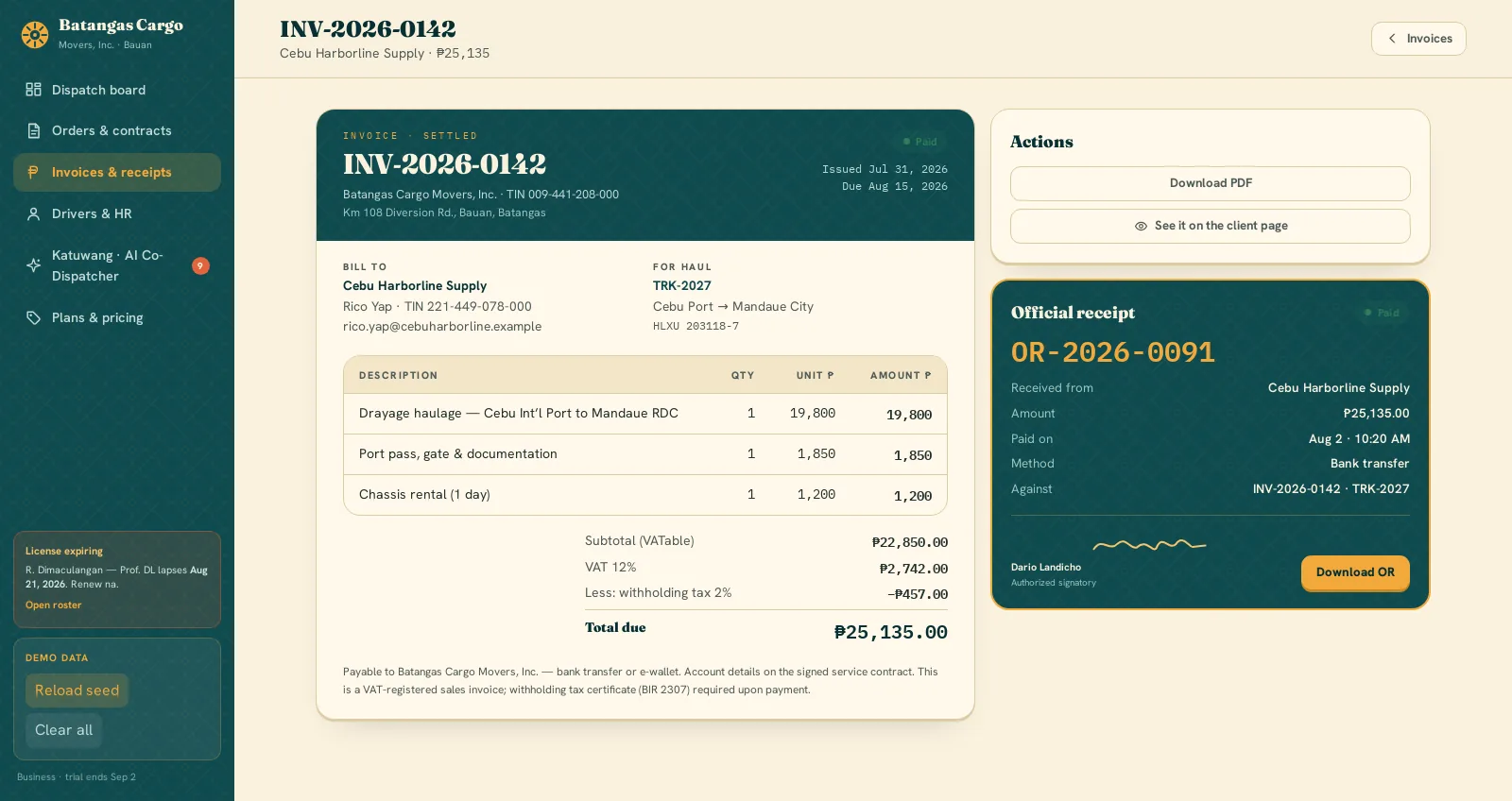
The billing screen design, same left rail with Invoices & receipts active. On the left, a teal-mastheaded VAT sales invoice INV-2026-0142 marked Paid, with bill-to and for-haul blocks, a three-line item table (drayage haulage, port pass and documentation, chassis rental), and a Subtotal → VAT 12% → less 2% withholding tax → Total due ₱25,135.00 ladder, closing with a note that this is a VAT-registered sales invoice requiring a BIR 2307 withholding certificate on payment. A narrow Actions panel beside it offers Download PDF and See it on the client page. On the right, a gold-on-teal Official Receipt card OR-2026-0091, also Paid, listing received-from, amount, paid-on date, payment method and the invoice it's applied against, with a hand-drawn signature line for an authorized signatory and a Download OR button.
Fig. 4Invoice and official receipt as a paired, VAT-aware ladder — subtotal, 12% VAT, 2% withholding — designed to hand a hauler the BIR paperwork trail alongside the payment record, not just a total due.
Pressed leaf — what it taught
The point of a gate is that it can stop things — a discovery process that always ends in a build isn't actually gated, it's just a longer runway to the same outcome. Stopping at a high-fidelity prototype kept the cost of finding out “not yet” cheap.