Acc. XVII · Sus provincia — provincial livestock marketplace, cultivated 2026
Backten — provincial livestock trade marketplace
Technical founder · Product engineer · 2026 · Independent studio
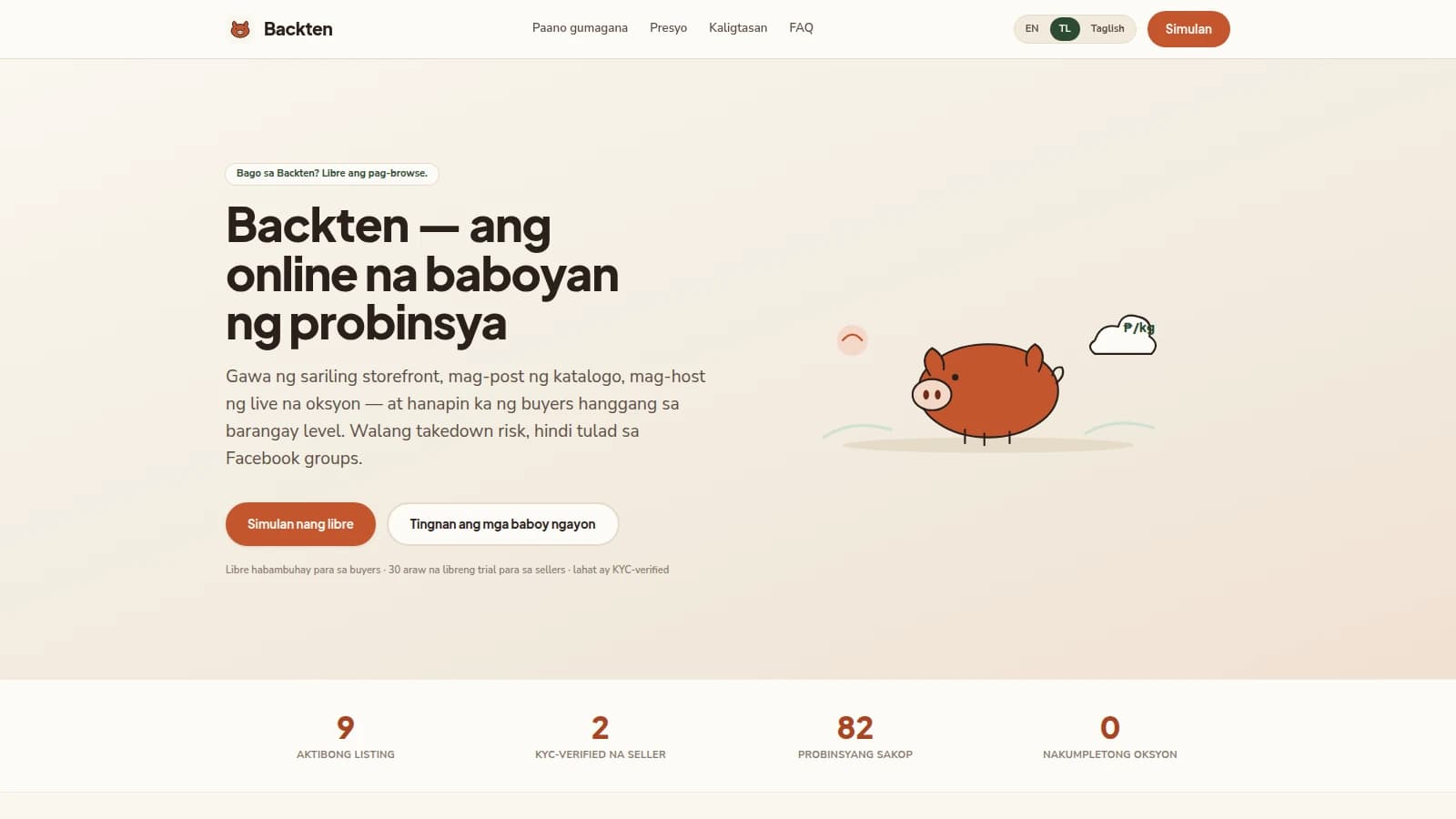
A multi-tenant, offline-first PWA marketplace connecting provincial pig farmers and buyers across the Philippines, retained as an engineering case study pending production configuration.
Sus provincia — provincial livestock marketplace, cultivated 2026
Field notes
The context
Provincial pig farmers and buyers in the Philippines trade largely outside any structured marketplace, with pricing, health information, and delivery arrangements handled ad hoc. A trustworthy exchange needs to work offline in low-connectivity provinces, verify who's on either side of a transaction, and enforce tenant isolation without relying on the UI to do it.
Cultivation
What I built
- Built intent-based onboarding with a buyer/seller mode toggle and KYC via face-matching.
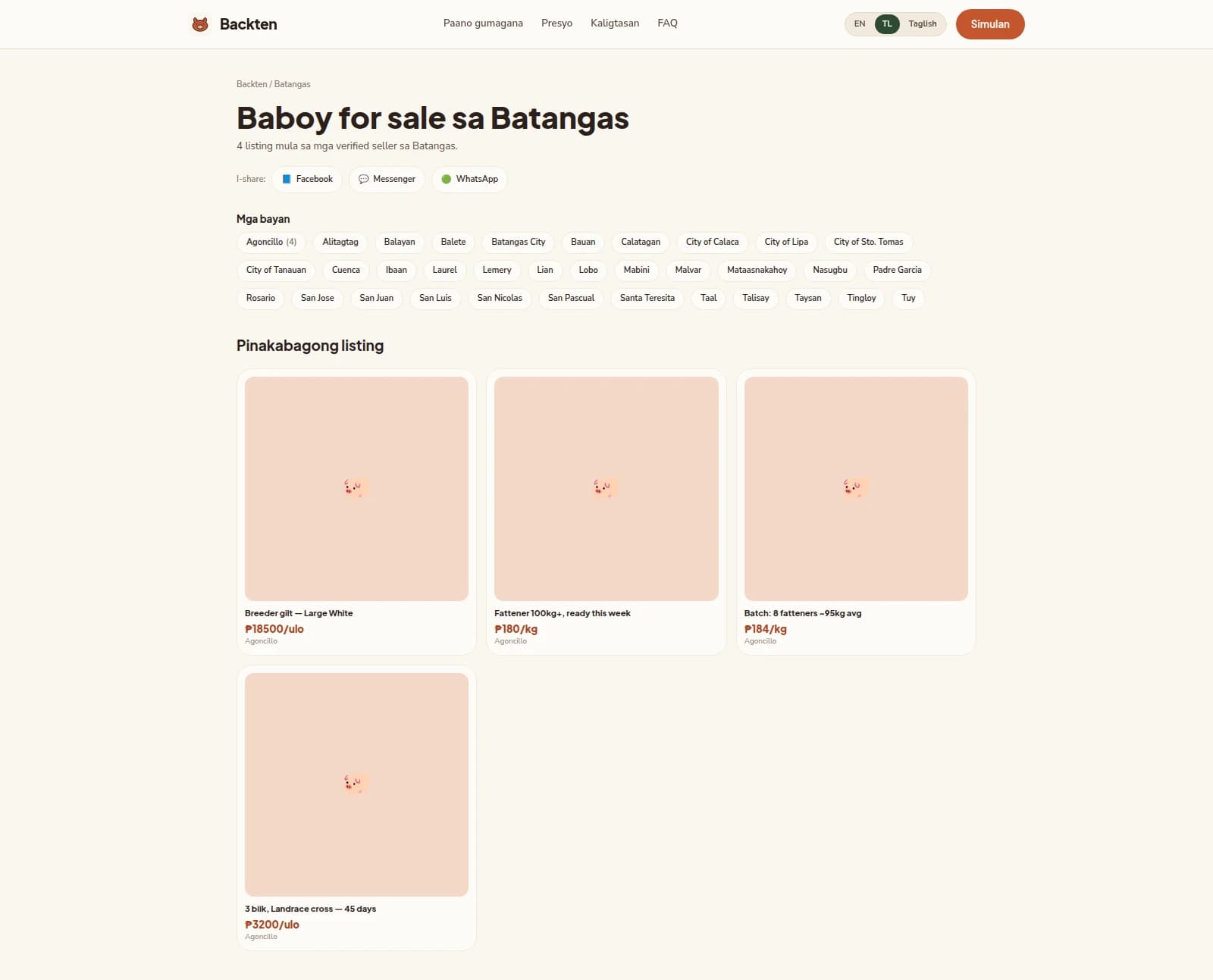
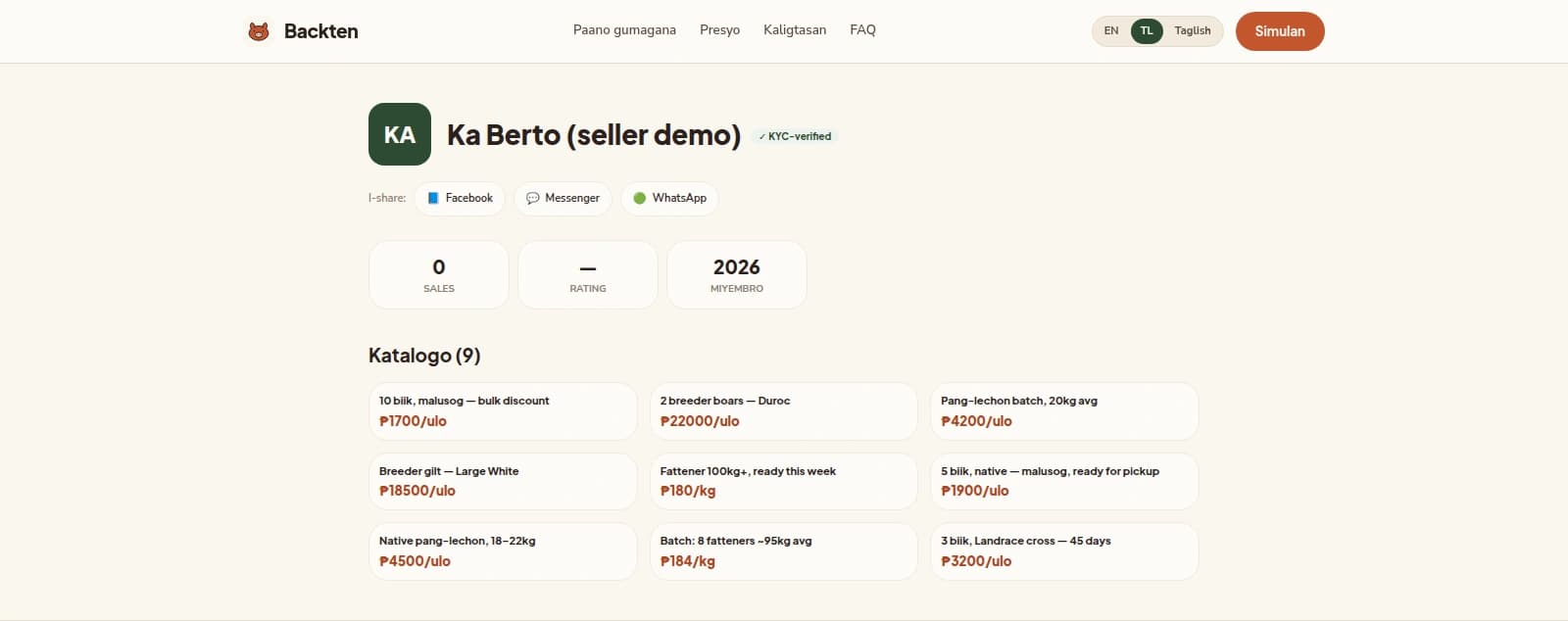
- Built seller storefronts with photo galleries and provincial categorisation drawn from the PSGC dataset, plus semantic search over pgvector combined with PSGC geographic filtering.
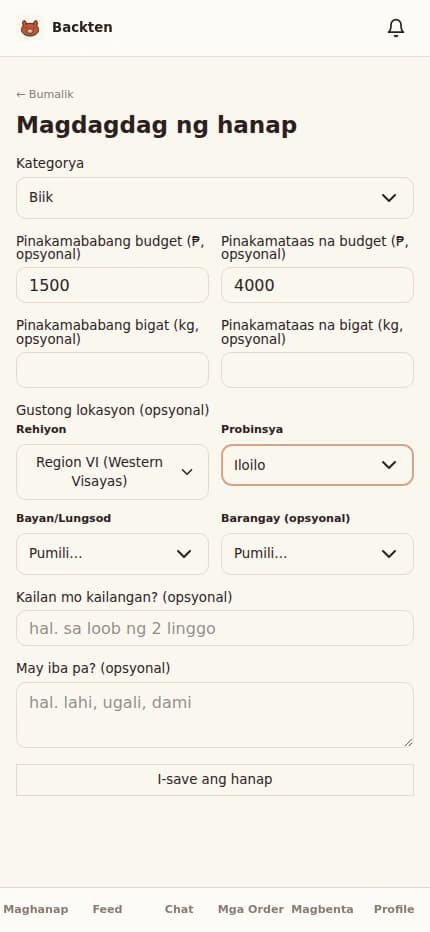
- Built live auctions with realtime bidding, preference-based buyer-seller matching, and a social feed, alongside an offline-first PWA with an IndexedDB outbox and local-first conflict handling.
- Built the order lifecycle — feedback, a photo receipt ledger, and delivery scheduling — plus subscriptions with manual payment verification (GCash/Maya/crypto), trials, dunning, and grace periods.
- Built Mission Control for tenant lifecycle, payment ops, and immutable audit logging enforced in Postgres, with tenant isolation enforced server-side in RLS rather than in the UI.
Root system
How it works
A pnpm and Turborepo monorepo with three surfaces — a Vite/React 19 mobile-first PWA, a Next.js landing site with SEO and PSGC permalinks, and a Vite Mission Control admin — built over seven shared packages, including @backten/psgc (43k province/city/barangay records) and @backten/llm-gateway (provider-fallback inference). Supabase carries 34 tables, 115 RLS policies, and 56 append-only migrations, with every access decision sitting downstream of receipt verification.
Harvest
Outcomes
- The build session completed and three Vercel projects are deployed, but production Supabase is deliberately not configured, so the deployed PWA and Mission Control are non-functional pending owner action.
- Feature tracker stands at 29 passing and 16 blocked, blocked mostly on environment and infrastructure decisions — secrets, CI billing, a Supabase production slot.
- Five E2E specs are authored but not yet executed; migrations 0130–0143 remain unapplied.
- Retained as an engineering case study, not a market-validation claim — described here accurately as a marketing surface with no functioning backend behind it yet.
Herbarium
The work itself
Enforcing tenant isolation in RLS rather than the UI layer meant the system's security posture didn't depend on every client surface getting it right. Deploying the surfaces before production infrastructure exists made the gap between “built” and “live” concrete and specific, rather than a vague caveat.